
In 1996, an extraordinary and unsettling medical event was reported in the New England Journal of Medicine, challenging long-held assumptions about cancer and contagion.
The case involved a 53-year-old surgeon in Germany and remains one of the rarest documented examples of direct cancer transmission between two individuals.
The incident began during surgery on a 32-year-old patient diagnosed with malignant fibrous histiocytoma (MFH), a rare and aggressive soft-tissue sarcoma arising from connective tissues.
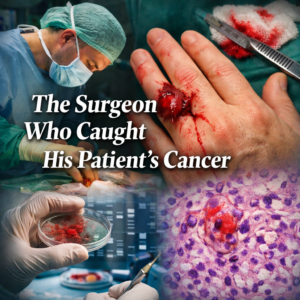
Worldwide, MFH is diagnosed in roughly 1,400 cases per year, making it an uncommon malignancy even among specialists. During removal of an abdominal tumor, the surgeon accidentally injured the palm of his left hand while placing a surgical drain. The wound was immediately disinfected and bandaged according to standard operating-room protocol.
Initially, the surgery was considered successful. Tragically, the patient later died due to postoperative complications unrelated to the tumor itself.
At the time, there was no indication that anything unusual had occurred beyond an occupational sharps injury—an unfortunate but recognized surgical risk.
Five months later, however, the surgeon noticed a firm, painless lump developing at the exact site of his earlier injury, near the base of his middle finger. Measuring about 3 cm in diameter, the mass prompted urgent medical evaluation. A biopsy confirmed the diagnosis: malignant fibrous histiocytoma—the same rare cancer as his former patient.
What made this case unprecedented was the subsequent genetic analysis. Advanced molecular testing, including short tandem-repeat polymorphism analysis and HLA gene sequencing, demonstrated that the surgeon’s tumor was genetically identical to the patient’s original cancer.
This finding provided definitive proof that viable tumor cells had been accidentally transferred from patient to surgeon during the operation, implanting themselves into the open wound and later proliferating.
Under normal circumstances, the immune system rapidly rejects foreign (allogeneic) cells, which is why organ transplants require immunosuppression. Interestingly, although the surgeon’s tumor was surrounded by intense inflammation—evidence of immune recognition—it continued to grow. Researchers suggested that the cancer cells may have partially evaded immune detection through limited antigen presentation or other molecular mechanisms, allowing them to survive in this exceptionally rare scenario.
The surgeon underwent complete surgical excision of the hand tumor. Two years of follow-up showed no recurrence or metastasis, confirming a successful outcome.
This case does not mean cancer is contagious through everyday contact. Rather, it highlights an extraordinarily rare risk of direct implantation of malignant cells following tissue injury. It underscores the critical importance of surgical safety measures—such as double-gloving, sharps awareness, and strict infection-control protocols—to protect healthcare professionals.
Decades later, this case still stands as a sobering reminder of medicine’s rare surprises and the delicate balance between tumor biology and human immunity.